Le Mans Bugatti
Le Mans Bugatti Notes:
The 24 Hours of Le Mans is the quintessential endurance race event, one of the most important competitions in Motorsports, held every year since 1929 (with a 10-year pause from 1939 to 1949) at the Circuit de la Sarthe in Le Mans, France. For being successful at Le Mans, a racecar needs to develop higher speed and, at the same time, to have outstanding reliability under long-distance racing conditions. The winner is the team that covers the most distance in 24 hours. The race runs in summer, with a high temperature and occasional rain getting the track surface wet.
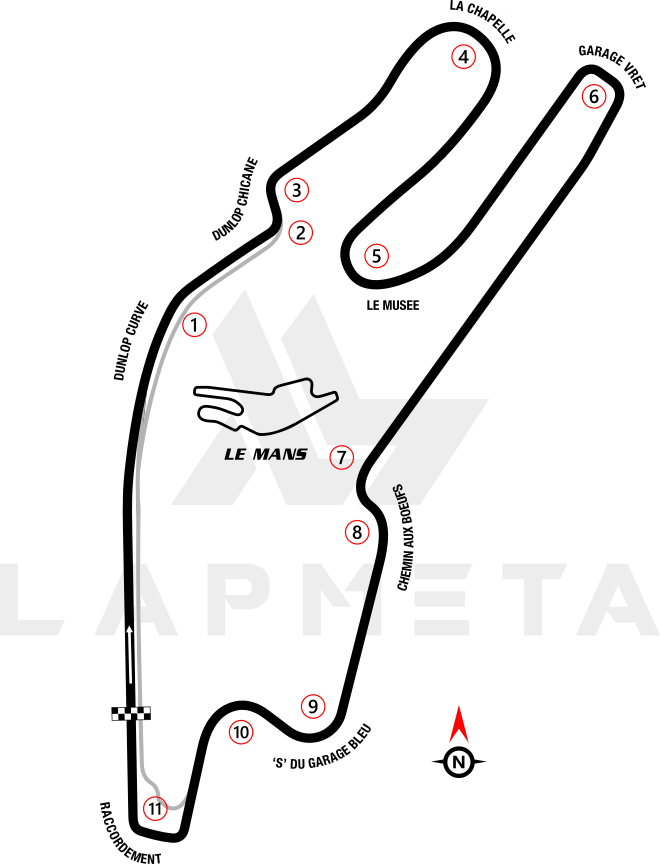
The 11-turn, 2.6-mile Circuit de la Sarthe in its current configuration is a highly technical layout offering a wide array of features that keep professional racers engaged the whole time they are behind the wheels. To get an average speed of 79 mph (127 km/h) on this difficult-to-maneuver circuit needs a fully-focused and experienced driver, let alone the particularities of completing the challenging 24 hours of nonstop racing. Teams replace drivers every 1-2 hours, but the precise interval depends on the team strategy. The whole trajectory is spectacular to the eye and fun to drive, with a different kind of challenge at every corner, a lot of overtaking opportunities, and an addictive experience every motorsports fan needs to take a look to.
Bugatti Notes:
Circuit de la Sarthe's Bugatti configuration delivers 4.185 kilometers of permanent road course racing through 11 turns, constructed in 1965 within the 24 Hours of Le Mans facility and named after Ettore Bugatti to provide a standalone circuit for events beyond the annual endurance classic. This clockwise layout incorporates iconic Le Mans sections including the main pit straight, Ford Chicane, and Dunlop bridge area before diverging through a tight hairpin section running parallel to the 24 Hours circuit back toward the paddock village, creating a compact technical challenge contrasting the 13.626-kilometer full Le Mans layout's high-speed character. The Bugatti Circuit's 2.6-mile distance with 11-meter elevation gain emphasizes tight corners and technical precision over sustained 300+ kph speeds, making it suitable for MotoGP motorcycle racing, club events, and series requiring shorter lap times than the full 24 Hours configuration permits.
The Bugatti Circuit's character emerges from sharing legendary Le Mans sections while maintaining independent compact layout. The Ford Chicane at lap end, pit complex, and Dunlop bridge straight connect Bugatti to 24 Hours mythology, but the tight hairpin section behind the pits creates entirely different rhythm from the full circuit's Mulsanne Straight and high-speed Porsche Curves. The famous Dunlop Chicane provides one of Bugatti's signature challenges—heavy braking into tight direction changes testing brake-turn precision. The circuit hosted Formula 1's 1967 French Grand Prix demonstrating versatility for different series, though modern use focuses on MotoGP (hosting French Grand Prix motorcycle racing), national series, and club events. Western France's temperate maritime climate creates moderate seasonal variation with frequent rain affecting grip levels on tight corners where water accumulation punishes early throttle application. The Bugatti Circuit's permanent infrastructure within the 24 Hours facility provides world-class paddock and spectator amenities uncommon at standalone club circuits. The configuration particularly serves as accessible alternative to the full Le Mans layout, where 4.185-kilometer laps and 11-turn technical character suit motorcycle racing and events requiring more laps per session than the 13.626-kilometer 24 Hours circuit allows, preserving Le Mans atmosphere while offering practical compact racing unavailable on the legendary endurance configuration.

| Name | Organization | Date |
|---|


