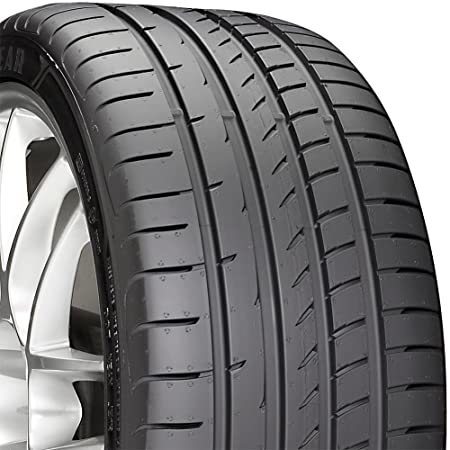
The Goodyear Eagle F1 GS-2 EMT is an ultra-high performance summer tire incorporating Extended Mobility Technology (EMT) for original equipment applications on premium performance vehicles requiring run-flat capabilities. This tire combines sporty performance characteristics with self-supporting run-flat technology allowing continued driving up to 50 miles at maximum speeds of 50 mph following complete air pressure loss, providing safety and convenience benefits that eliminate concerns about being stranded due to tire punctures. The Eagle F1 GS-2 EMT features solid centerline and large shoulder elements delivering responsive steering input and confident cornering capabilities, while full-depth circumferential grooves and directional tread pattern provide efficient water evacuation for excellent wet traction. Goodyear recommends Extended Mobility Technology tires exclusively for vehicles originally equipped with self-supporting run-flat tires and equipped with tire pressure monitoring systems.
The Goodyear Eagle F1 GS-2 EMT carries impressive UTQG ratings of 300 AA A reflecting its balanced approach between ultra-high performance capabilities and reasonable durability expectations. Available specifications include multiple sizes with Y speed ratings (up to 186 mph) appropriate for high-performance applications, with example 245/40ZR18 sizing delivering 25.7-inch overall diameter, 10/32-inch tread depth, and load capacity of 1,235 pounds at maximum 44 psi inflation pressure. The tire utilizes measured rim width of 8.5 inches with acceptable range from 8.0 to 9.5 inches for proper fitment. The reinforced sidewall construction required for run-flat capability typically results in slightly firmer ride quality compared to non-run-flat alternatives, though Goodyear has optimized the design to minimize this trade-off while maintaining the responsive handling and wet/dry traction characteristics expected from ultra-high performance applications. Like all summer tires, the Eagle F1 GS-2 EMT is not intended for operation in near-freezing temperatures, through snow, or on ice where compound characteristics become unsuitable for safe operation.